
The oil is still moving. That does not mean the system is normal.
Gulf producers and buyers are using shuttle movements and ship-to-ship transfers in the Gulf of Oman to preserve crude flows while exposure inside the Strait of Hormuz remains elevated. The system demonstrates operational resilience, but it does so by adding vessels, handovers, time and contractual complexity to each movement.
The workaround
Reuters reported that ship-to-ship transfers in the Gulf of Oman were expected to handle about 2.5 million barrels per day in September, up from 1.4 million barrels per day in August. Separate Reuters reporting said Saudi Arabia had sold about 60 million barrels from Ras Tanura for transfer at Sohar during September and October.
In practical terms, cargo can be moved out of the Gulf on a vessel prepared to accept the Hormuz exposure and then transferred outside the strait to another tanker for the longer voyage. This protects physical flow, but it does not recreate the efficiency or optionality of normal through-transit.
The price signal
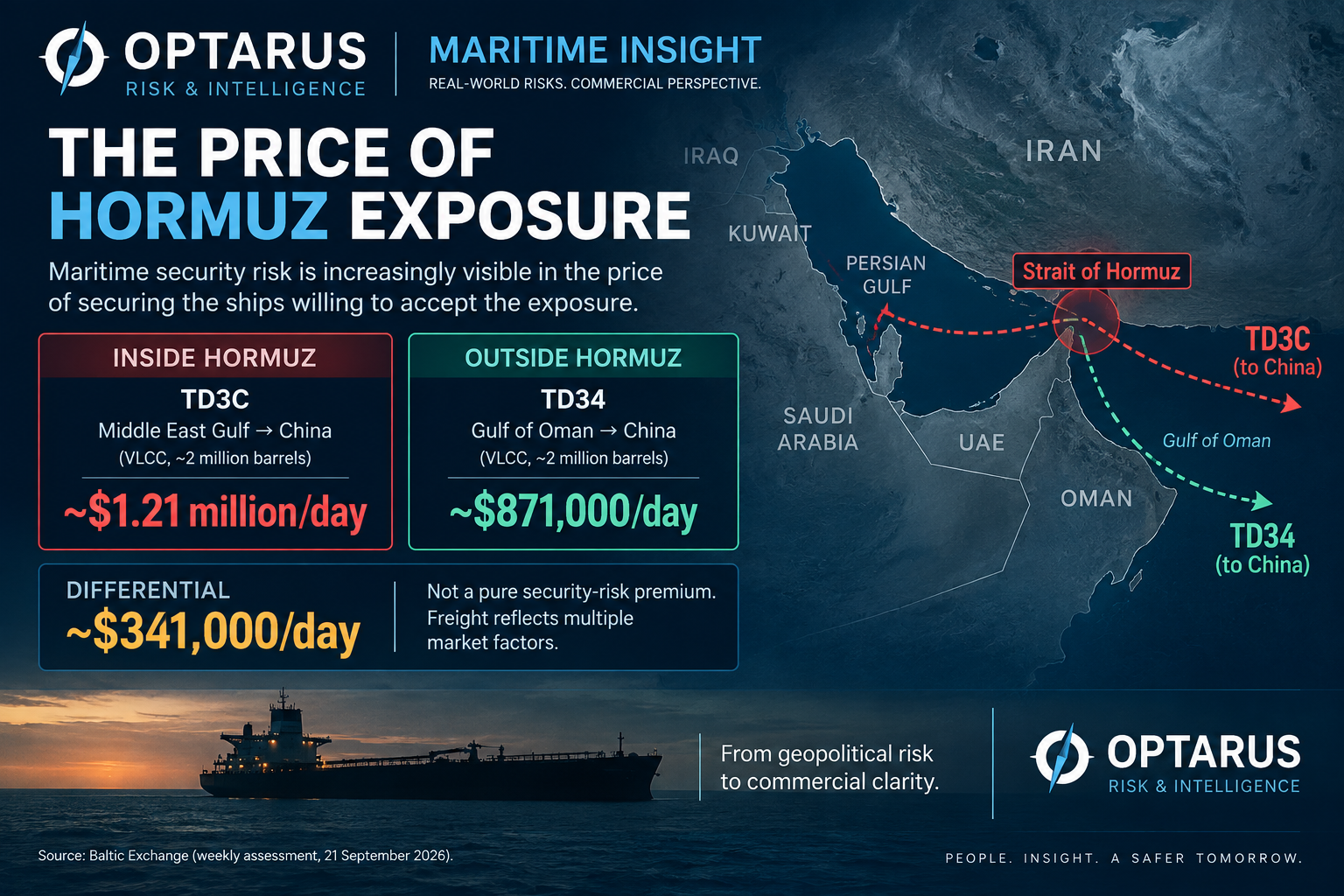
The Baltic Exchange's Week 38 assessments put a visible price on the separation between loading inside and outside the strait:
| Route | Exposure | Round-trip TCE |
|---|---|---|
| TD3C · Middle East Gulf to China | Requires Hormuz transit | $1,212,503/day |
| TD34 · Gulf of Oman to China | Loads outside Hormuz | $870,947/day |
| Difference | Market separation | $341,556/day |
The difference is not a pure “Hormuz security premium”. Freight reflects multiple market factors, and the figures are time-charter-equivalent earnings assessments rather than simple daily hire invoices. Nevertheless, the separation is a strong indication of how geopolitical exposure is moving through the tanker market.
A chokepoint does not have to be fully closed before it begins imposing substantial commercial cost.
How the exposure moves
If fewer owners are prepared to accept the voyage profile, the effective vessel pool contracts. Owners willing to trade can command exceptional returns, while shuttle movements and transfer operations consume vessel-days that would otherwise remain available to the wider market.
The commercial effects do not stop with owners and charterers. Additional cargo handling creates further collision, pollution and cargo-integrity exposure; schedules become more vulnerable to delay; crews and marine-service providers carry a greater operational burden; and responsibility for cost or performance can become harder to allocate across contracts.
A new concentration point
The workaround moves cargo beyond the original chokepoint, but it also concentrates vessels, cargo, people and support activity in a smaller number of predictable offshore transfer areas. That creates a different risk geometry: congestion and casualty accumulation, dependence on pilots and service craft, weather sensitivity, transfer-slot constraints and potential insurance accumulation outside the strait.
Commercial meaning
Falling or stabilising crude prices should not, by themselves, be treated as evidence of maritime normalisation. Physical barrels can keep moving while shipping efficiency, prompt tanker availability and route flexibility remain impaired. The East-West Pipeline can reduce pressure if capacity and Yanbu loadings recover, but partial restoration does not remove the need to watch Hormuz traffic and the offshore transfer system together.
The relevant question is therefore no longer simply whether a vessel can transit Hormuz. It is how much capacity, complexity and retained risk the market must absorb to accept — or work around — the exposure.
What to watch next
- Visible and estimated Strait of Hormuz transit volumes.
- Gulf of Oman ship-to-ship transfer volumes, waiting time and congestion.
- Prompt VLCC availability and the TD3C–TD34 earnings relationship.
- Saudi East-West Pipeline throughput and Yanbu crude loadings.
- Changes to war-risk terms, P&I guidance or owner trading restrictions.
- Casualty, pollution, security or service-capacity incidents around transfer areas.