
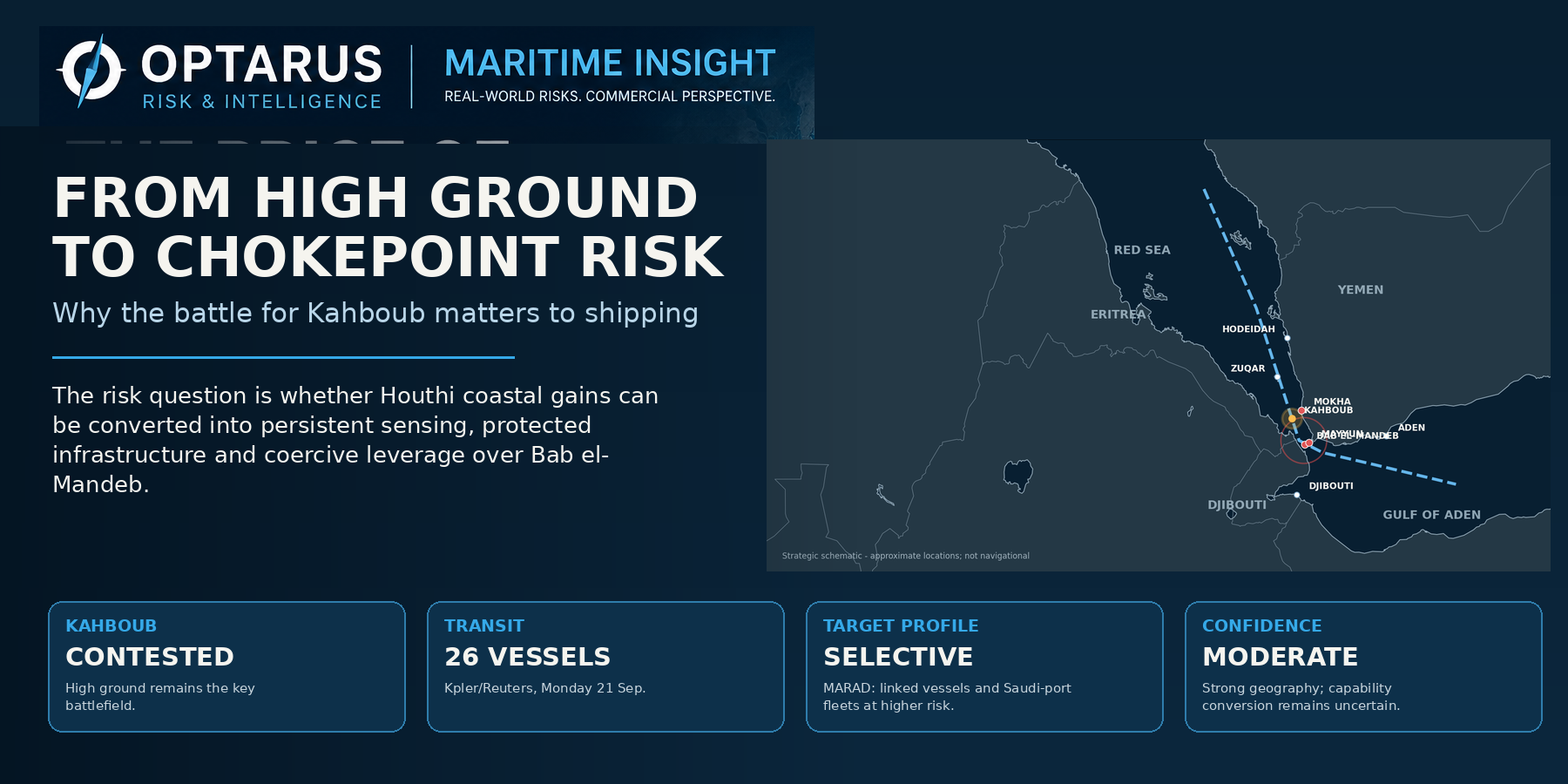
The battle for Kahboub is not yet a shipping-disruption event, but it sits above a maritime threat environment that is already active and selective.
Commercial traffic continues through Bab el-Mandeb and Kahboub remains contested. No reliable public evidence yet establishes a functioning new radar-to-strike architecture. The decision-relevant issue is whether new coastal depth and high-ground control can make an existing maritime threat more persistent, survivable and coercive.
Current operating picture
| Issue | Evidence status | Current judgement |
|---|---|---|
| Kahboub high ground | Contested | Fighting continues; decisive and durable control is not established. |
| Selective vessel-targeting profile | Confirmed | Official maritime guidance identifies specified vessel associations and Saudi-port links as higher risk. |
| Reported radar and tunnel work | Attributed | Specific reporting remains source-attributed; operational status is not independently verified. |
| New integrated sensing and strike architecture | Not established | Public evidence does not demonstrate a functioning new sensor-to-shooter network. |
Commercial consequence
The operational question is not simply whether Bab el-Mandeb is open today. It is whether territorial depth, sensing, protected infrastructure, closer engagement geometry and demonstrated maritime weapons could raise the probability, duration or selectivity of future disruption enough to change routing, insurance and security posture.
Current posture: continued transit inside a selective and evolving threat environment—not closure of the strait.
Indicators that would materially change the judgement
- Multi-source confirmation of durable Houthi control of the Kahboub ridge and access routes.
- Independent confirmation of operational maritime radar or surveillance sites.
- A confirmed attack or attempted attack against a commercial vessel in or near the southern Red Sea or Bab el-Mandeb.
- A material multi-day decline in crossings, diversions or AIS-dark behaviour tied to threat reporting.
- Further insurance notification changes, explicit restrictions or material market response tied to the changed coastal position.
Confidence and evidence boundary
Moderate confidence that the Kahboub contest has direct maritime relevance. Confidence is high that the current threat profile is selective rather than universal, but low-to-moderate on the scale and maturity of any new sensing or fortification architecture.
Methodology and safeguards
This publication separates confirmed developments, attributed reporting, analytical assessment and unresolved uncertainty. Analyst-directed AI tools supported source retrieval, comparison, drafting, visualisation and quality control. Analytical judgements, attribution decisions and publication thresholds were reviewed against the cited open sources before release; AI assistance does not replace source verification or analyst accountability.