
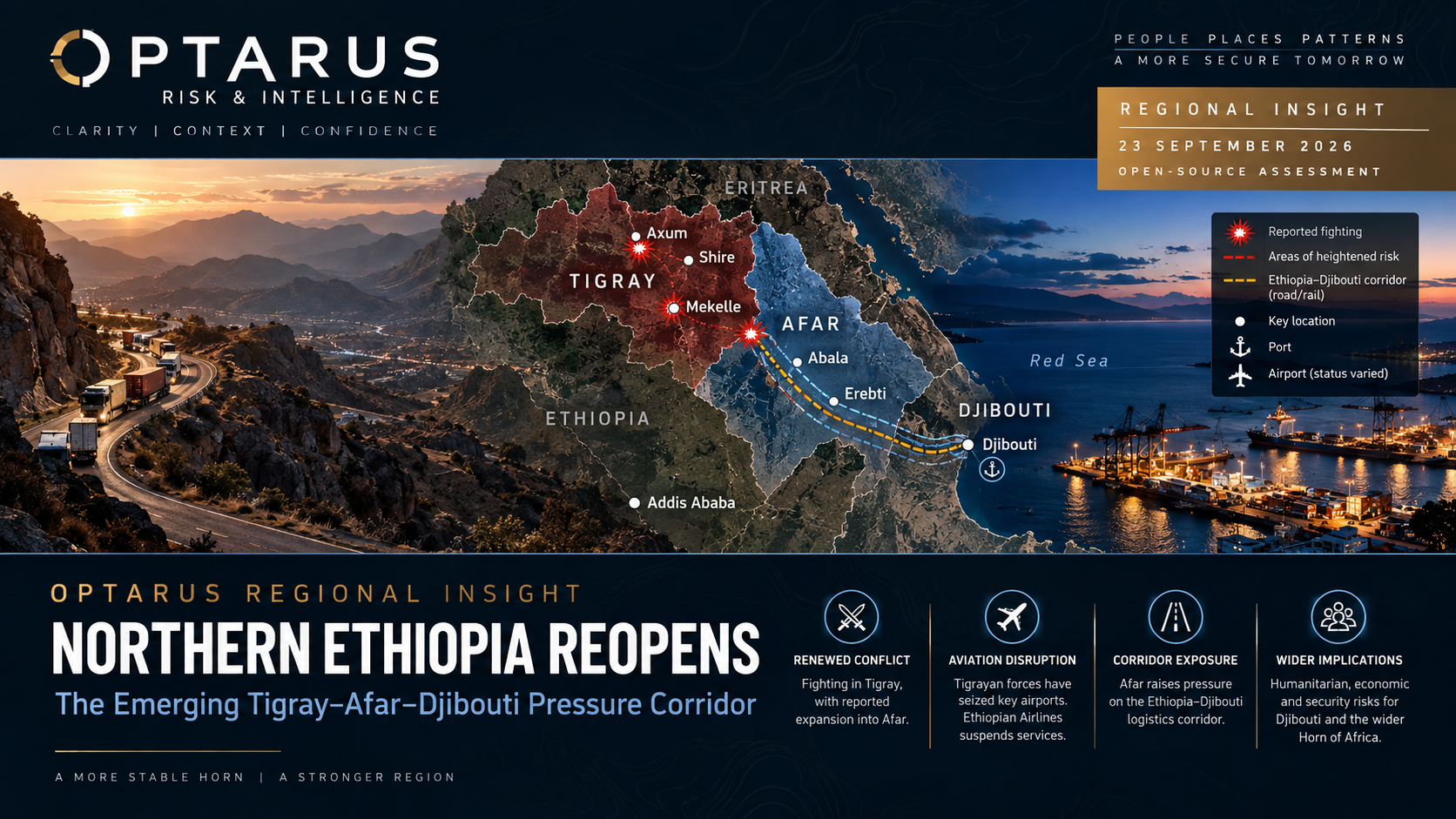
Renewed fighting in northern Ethiopia has crossed from political-security deterioration into a major conflict event.
The immediate operational effects are concentrated in Tigray and adjacent areas, but fighting in Afar creates a plausible transmission pathway toward systems that matter to Ethiopia and Djibouti. The Ethiopia–Djibouti strategic corridor is not presently confirmed as disrupted, and no reliable evidence yet establishes new conflict-driven displacement from Ethiopia into Djibouti.
What changed
The morning evidence refresh confirmed a major new phase of fighting, the seizure of the federally controlled airports at Mekelle, Axum and Shire, disruption to civilian air services and fighting in Afar. It did not establish interruption to the Addis Ababa–Djibouti commercial system or a new Ethiopia-origin displacement flow into Djibouti.
| Issue | Evidence status | Current judgement |
|---|---|---|
| Major renewed Tigray–federal fighting | Confirmed | Multiple high-quality sources describe a new major round of hostilities. |
| Mekelle, Axum and Shire airports seized | Confirmed | Reuters, AP and the African Union identify the airports as seized or occupied by Tigray forces. |
| Fighting in Afar | Corroborated | Reporting supports clashes in Afar; precise territorial control remains unclear. |
| Seven-group alliance | Confirmed | The alliance is established; effective unified command remains unproven. |
| Ethiopia–Djibouti corridor disrupted | Not established | No reliable evidence of road, rail, customs, fuel or port-system interruption was identified. |
| New Ethiopian displacement into Djibouti | Not established | Djibouti is receiving Yemeni arrivals, but no reliable new Tigray- or Afar-origin flow was identified. |
Tigray → Afar → Djibouti
Tigray: conflict core
Tigray is the current conflict core. Responsibility for initiating the latest phase remains contested, but the existence and scale of renewed hostilities are established. The seizure of three airports disrupts scheduled civilian access and complicates humanitarian and diplomatic movement.
Afar: transmission geography
Afar is the key collection problem. Clashes around northern approaches such as Abala and Erebti do not by themselves demonstrate that the national trade corridor is compromised. The decisive question is whether fighting moves materially east or south and begins affecting road access, fuel movement, trucking, customs nodes, rail operations or humanitarian staging.
Djibouti: consequence geography
Djibouti does not need to become a combat theatre to experience material effects. Increased humanitarian arrivals, transport rerouting, contractor demand, diplomatic movement, force-protection requirements or port and airport activity could create operating pressure while fighting remains inside Ethiopia.
Commercial exposure without confirmed disruption
World Bank material states that more than 95% of Ethiopia's import-export trade by volume uses the Addis–Djibouti corridor. The relationship is a shared vulnerability: Ethiopia depends on maritime access through Djibouti, while Djibouti depends heavily on Ethiopian cargo and related logistics activity.
Current commercial posture: exposure monitoring, not disruption reporting.
A material change would require evidence such as verified road or rail delay, fuel or customs interruption, trucking shortages, route restrictions, deeper eastward fighting in Afar, or a measurable rise in conflict-driven displacement toward Djibouti or key logistics hubs.
Djibouti's pressure stack
Djibouti is already absorbing consequences from the Red Sea conflict. UNHCR reported nearly 3,000 arrivals from Yemen in less than a week in mid-September. The country also hosts a dense concentration of foreign military infrastructure. This does not link the Tigray conflict to those facilities; it means any broader deterioration would occur in a location already carrying high humanitarian, commercial and strategic sensitivity.
Political-military context
The Ethiopian Peoples' Forces Alliance for Survival brings together seven organisations that previously operated across different theatres and, in some cases, fought on opposing sides. Its formation changes the strategic frame, but public evidence does not yet demonstrate an integrated seven-group command structure or sustained coordinated operations across multiple regions.
Three pathways from here
H1 · Contained northern conflict
Fighting remains concentrated in Tigray, southern Tigray, northern Afar and Amhara approaches. Civilian aviation disruption persists, but the national corridor remains operational.
H2 · Afar pressure develops
Conflict moves materially deeper into Afar or creates sustained displacement and route insecurity. Commercial systems face delays, security controls or humanitarian competition without necessarily being severed.
H3 · Wider Ethiopian conflict system
Alliance members demonstrate meaningful coordinated operations across multiple regions, forcing federal dispersion and increasing risk to strategic infrastructure and economic systems.
At publication, the operating picture sits between H1 and the early conditions required for H2. H3 has strengthened as a watch case, but unified command and sustained multi-theatre coordination are not established.
Forward indicators
- Fighting moving materially deeper into Afar or onto routes feeding strategic east–west movement.
- Verified road, rail, fuel, customs, trucking or dry-port disruption linked to the conflict.
- Confirmed new displacement from Tigray or Afar toward Djibouti or major eastward staging hubs.
- Further airport seizures, military use of civilian airfields or aviation disruption beyond Tigray.
- Independent evidence of Eritrean forces, external weapons or external personnel entering the theatre.
- Demonstrated coordinated multi-region operations, common command, logistics or targeting.
- Verified cessation, reopening of airports and sustained corridor continuity as lowering indicators.
Confidence and bottom line
Moderate-high confidence in the deterioration of the northern security environment; moderate confidence in Afar's significance as an emerging transmission geography; low confidence in any claim that the Addis–Djibouti corridor is currently disrupted or that Djibouti is already receiving conflict-driven arrivals from Ethiopia.
Northern Ethiopia is again an active conflict system. Afar is the key transmission geography to monitor. Djibouti is not presently part of the conflict theatre, but its dependence on Ethiopian trade, current Yemen-related humanitarian load and strategic concentration make it the most important downstream location for second-order effects.
Methodology and safeguards
This publication separates corroborated developments, attributed claims, unresolved reporting and Optarus analytical inference. Analyst-directed AI tools supported source retrieval, comparison, drafting and quality control. Analytical judgements, attribution decisions and publication thresholds were reviewed against the cited open sources before release; AI assistance does not replace source verification or analyst accountability.
Selected sources
- Reuters — Tigrayan leaders say new war with Ethiopian government has begun
- Reuters — Why new war in Ethiopia's Tigray threatens to trigger wider conflict
- Associated Press — Ethiopian Airlines cancels flights to Tigray as fighters take over airport
- Associated Press — Ethiopian opposition groups unite to mount challenge to Prime Minister Abiy
- African Union — Call for restraint and immediate de-escalation in northern Ethiopia
- World Bank — Addis–Djibouti corridor connectivity and trade
- UNHCR — More help urgently needed as thousands arrive in Djibouti fleeing Yemen
- CSIS — Extended Range: China Upgrades Its Military Base in Djibouti
- Bellingcat — Is Ethiopia Flying Iranian-Made Armed Drones?
- ACLED — Ethiopia conflict analysis